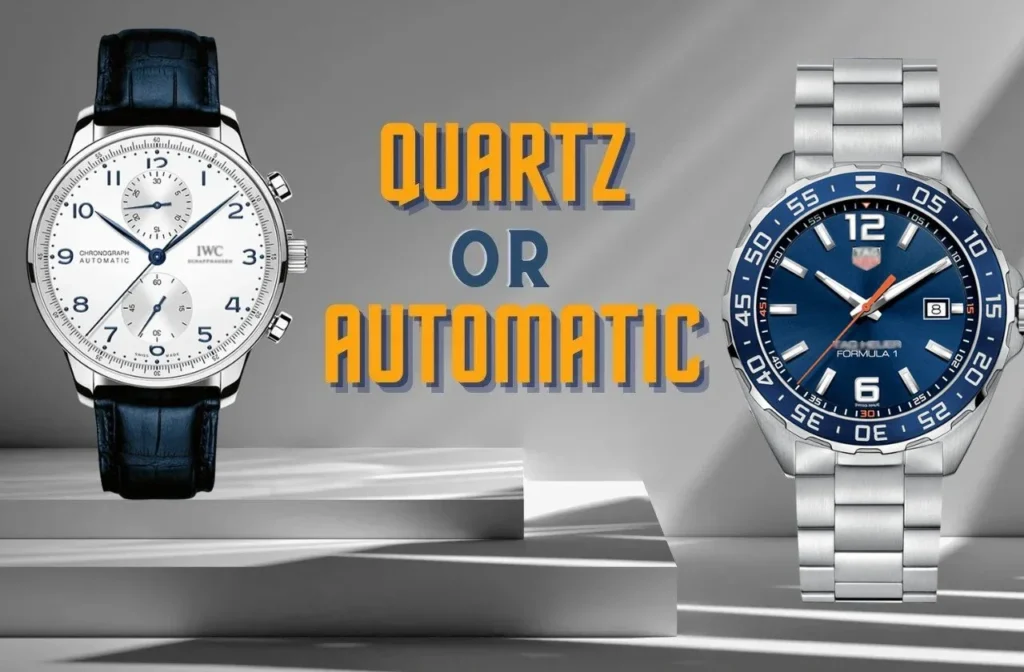
Choosing the right watch involves more than selecting a design that looks good on your wrist. The movement inside a watch determines how it keeps time, how much maintenance it needs, and what kind of experience it offers.
When comparing a quartz vs automatic watch, you will find that both types have their own advantages. Quartz watches are known for their accuracy and convenience, while automatic watches attract people who appreciate traditional watchmaking and mechanical craftsmanship.
But which one is right for you?
In this guide, we will explain how quartz and automatic watches work, compare their accuracy, maintenance, durability, and cost, and help you decide which type best suits your everyday needs.
What Is a Quartz Watch?
A quartz watch is a timepiece that uses a battery and a quartz crystal to measure time. It is one of the most common types of watches because it is generally accurate, reliable, and easy to maintain.
Inside the watch, the battery sends an electrical current through a small quartz crystal. The crystal vibrates at a consistent frequency, and the watch’s electronic circuit uses those vibrations to measure time and move the hands or update the digital display.
Most traditional quartz watches use a battery, although some models use rechargeable power systems.
How Does a Quartz Watch Work?
The working mechanism of a quartz watch involves three main components:
- Battery: Supplies electrical energy to the watch.
- Quartz crystal: Vibrates at a stable frequency when electricity passes through it.
- Electronic circuit: Converts the vibrations into accurate timekeeping signals.
In an analogue quartz watch, these signals drive a small motor that moves the hands around the dial.
Because the mechanism is relatively simple compared with a traditional mechanical watch, quartz watches are often affordable and require less frequent servicing.
Advantages of Quartz Watches
1. High accuracy
Quartz watches generally keep time more accurately than ordinary mechanical watches. Their electronic timekeeping system is less affected by everyday movement and changes in wearing habits.
2. Low maintenance
Quartz watches usually require a battery replacement after a period of use. The exact interval depends on the model, battery, and additional features.
3. Convenient everyday use
You can leave a quartz watch unused for a while and typically return to find it still keeping time, provided its battery has sufficient power.
4. Wide range of designs
Quartz movements can be found in everything from simple everyday watches to elegant formal timepieces and feature-rich sports watches.
5. Often more budget-friendly
Quartz watches are commonly less expensive to manufacture and purchase than comparable mechanical watches, making them accessible to a wide range of buyers.
Disadvantages of Quartz Watches
Despite their practical benefits, quartz watches have a few limitations.
- They depend on a battery or another electrical power source.
- Battery replacement may be necessary during ownership.
- Some watch enthusiasts prefer the mechanical craftsmanship of automatic movements.
- A quartz watch may offer less appeal to someone specifically interested in traditional mechanical watchmaking.
These points do not make quartz watches inferior. They simply make them better suited to certain preferences.
What Is an Automatic Watch?
An automatic watch is a mechanical timepiece that winds itself using the natural movement of the wearer’s wrist.
Unlike a typical quartz watch, an automatic watch does not rely on a battery to power its timekeeping mechanism. Instead, it uses a system of gears, springs, and other mechanical components to store and release energy.
Automatic watches are often appreciated for their engineering, craftsmanship, and connection to traditional watchmaking.
How Does an Automatic Watch Work?
An automatic watch contains several important components:
- Rotor: A moving weight that rotates as the wrist moves.
- Mainspring: Stores energy generated by the winding mechanism.
- Gear train: Transfers energy through the movement.
- Escapement: Regulates the release of energy.
- Balance wheel: Oscillates to help control the watch’s timekeeping.
As you move your wrist, the rotor winds the mainspring. The stored energy then powers the mechanical movement.
Most automatic watches also allow manual winding through the crown, although the exact features depend on the model.
Advantages of Automatic Watches
1. No regular battery replacement
Automatic watches do not require a conventional battery for their mechanical movement. However, they still need appropriate maintenance and occasional servicing.
2. Traditional craftsmanship
The intricate components inside an automatic watch can make it especially appealing to people who appreciate mechanical engineering and horology.
3. A distinctive wearing experience
Many automatic watches have a smooth, continuous-looking movement of the seconds hand. The precise appearance varies by movement.
4. Long-term ownership potential
With proper care and periodic servicing, a quality automatic watch can provide years of use. Some mechanical watches are even passed down through generations.
5. Mechanical appeal
For collectors and enthusiasts, the attraction is not simply telling time. It is also understanding and appreciating the mechanism that makes the watch work.
Disadvantages of Automatic Watches
Automatic watches also have practical considerations.
- They can lose or gain more time than typical quartz watches.
- They may stop running when left unworn long enough for their stored energy to run out.
- They generally require more specialised servicing.
- Comparable automatic models often cost more than quartz alternatives.
- Their timekeeping can be affected by factors such as position, temperature, and the condition of the movement.
An automatic watch may be an excellent choice for someone who enjoys mechanical craftsmanship, but it is not automatically the best option for every buyer.
Quartz vs Automatic Watch: Key Differences
Understanding the main differences makes it easier to choose a watch that fits your lifestyle.
| Feature | Quartz Watch | Automatic Watch |
|---|---|---|
| Power source | Battery or electronic power system | Mechanical energy stored in a mainspring |
| Timekeeping | Generally more accurate | Usually less accurate than quartz |
| Maintenance | Usually lower | Usually higher |
| Battery replacement | Usually required for battery-powered models | Not required for the mechanical movement |
| When left unworn | Usually continues running while powered | Eventually stops when its power reserve runs out |
| Mechanism | Electronic | Mechanical |
| Typical cost | Often more affordable | Often more expensive |
| Best suited for | Convenience and everyday practicality | Mechanical craftsmanship and watchmaking enthusiasts |
Keep in mind that these are general comparisons. Actual accuracy, price, durability, and maintenance requirements vary by model and manufacturer.
Which Is More Accurate: Quartz or Automatic?
Accuracy is one of the biggest differences between a quartz vs automatic watch.
Quartz watches are generally more accurate because they use the consistent vibrations of a quartz crystal and an electronic circuit to measure time. Many ordinary quartz watches deviate by only a small number of seconds per month, although the exact specification depends on the model.
Automatic watches rely on mechanical components that regulate the release of stored energy. Their accuracy can be influenced by the movement’s design, adjustment, position, temperature, and condition.
As a result, many ordinary automatic watches can gain or lose several seconds per day. Higher-grade and carefully regulated mechanical watches may perform better.
Which should you choose?
If accurate timekeeping with minimal adjustment is your priority, a quartz watch is generally the more practical option.
If you are comfortable with small variations in timekeeping and value mechanical craftsmanship, an automatic watch may be more appealing.
Which Watch Requires Less Maintenance?
Maintenance is another important consideration, especially if you want a watch that fits easily into your daily routine.
Quartz Watch Maintenance
A battery-powered quartz watch generally needs a battery replacement when its power runs low. The frequency depends on the model and its features.
You should also keep the case and strap clean, protect the watch from impacts, and follow the manufacturer’s instructions regarding water resistance.
Some quartz watches have rechargeable systems or solar-powered technology, so their maintenance requirements can differ from those of standard battery-powered models.
Automatic Watch Maintenance
Automatic watches require attention to both everyday care and the condition of their mechanical movement.
Regular wear keeps an automatic watch wound, provided the movement receives enough motion. If it remains unworn for too long, it will eventually stop and may need to be wound and reset.
Mechanical components also experience wear over time. Periodic professional servicing may be necessary, depending on the manufacturer’s recommendations, the movement, and how the watch is used.
The verdict: Quartz watches are generally easier and less expensive to maintain. Automatic watches require more attention but can reward owners who enjoy caring for a mechanical timepiece.
Which Is Better for Everyday Wear?
The best watch for everyday wear depends on your routine, personal style, and expectations.
A watch should be comfortable, easy to read, appropriate for your regular activities, and practical enough to wear without constant concern.
Choose Quartz for Everyday Convenience
A quartz watch may suit you if:
- You want reliable and accurate timekeeping.
- You prefer a low-maintenance accessory.
- You do not want to reset your watch after leaving it unused.
- You need a practical timepiece for college, work, travel, or daily errands.
- You want more flexibility within a particular budget.
A simple quartz watch with a clean dial and a comfortable strap can work well with casual clothing, office outfits, and formal wear.
Choose Automatic for Mechanical Craftsmanship
An automatic watch may suit you if:
- You appreciate traditional watchmaking.
- You enjoy understanding how mechanical objects work.
- You wear your watch frequently enough to keep it wound.
- You do not mind occasional adjustments and professional servicing.
- You prefer a mechanical timepiece over an electronic movement.
An automatic watch can also complement everyday outfits, business clothing, and more formal occasions.
Neither movement determines whether a watch looks elegant. Dial design, proportions, finishing, materials, and overall construction all contribute to its appearance.
Are Automatic Watches Better Than Quartz Watches?
There is no universal winner in the quartz vs automatic watch comparison. The better option depends on what you value.
An automatic watch is not automatically more luxurious simply because it contains a mechanical movement. Similarly, a quartz watch is not necessarily low quality because it uses a battery.
A well-designed quartz watch can be reliable, elegant, and practical. A well-made automatic watch can offer impressive craftsmanship and an engaging mechanical experience.
When comparing watches, consider the complete product rather than focusing on the movement alone.
Look at the quality of the case, the clarity of the dial, the comfort of the strap, the manufacturer’s reputation, the warranty, and the availability of after-sales service.
If you are buying your first watch, convenience and comfort may matter more than the type of movement. If you already own several watches, you may enjoy exploring the different characteristics of mechanical timepieces.
What Should You Consider Before Buying a Watch?
Before purchasing either a quartz or automatic watch, consider the following factors.
1. Your Budget
Set a realistic budget and compare watches within it. Remember to consider long-term maintenance costs, not just the initial purchase price.
2. Your Lifestyle
Think about when and where you will wear the watch. A simple everyday watch may be more useful than a complicated design if you need something for regular use.
3. Design and Comfort
Choose a case size that feels comfortable on your wrist. Pay attention to the weight, strap material, dial readability, and overall proportions.
4. Maintenance Requirements
Consider whether you prefer a watch that requires minimal attention or one that needs more specialised care.
5. Brand Reliability
Check the warranty, product specifications, customer support, and service options before purchasing.
6. Features and Materials
Look at the features that genuinely matter to you, such as water resistance, a date display, scratch-resistant crystal, and strap adjustability. Verify the specifications of the exact model instead of assuming all watches offer the same protection.
Final Verdict: Quartz vs Automatic Watch
Both quartz and automatic watches have distinct advantages, and the right choice comes down to your priorities.
Quartz watches are generally better for people who value accuracy, convenience, and straightforward maintenance. Automatic watches are appealing to those who appreciate mechanical engineering, traditional craftsmanship, and the experience of owning a self-winding timepiece.
You do not need to choose a watch simply because one movement is considered more prestigious than the other. A good watch should fit your needs, complement your personal style, and offer dependable performance for its intended use.
At VELORIS, the idea of timeless style begins with choosing thoughtfully. Whether you prefer the convenience of quartz or the mechanical character of an automatic movement, understanding the differences helps you make a more confident decision.
Ultimately, the best watch is the one that works for your lifestyle and feels right every time you wear it.
Know more about: The Tick of Time: Why the Mechanical Watch Outlived Its Own Obsolescence